
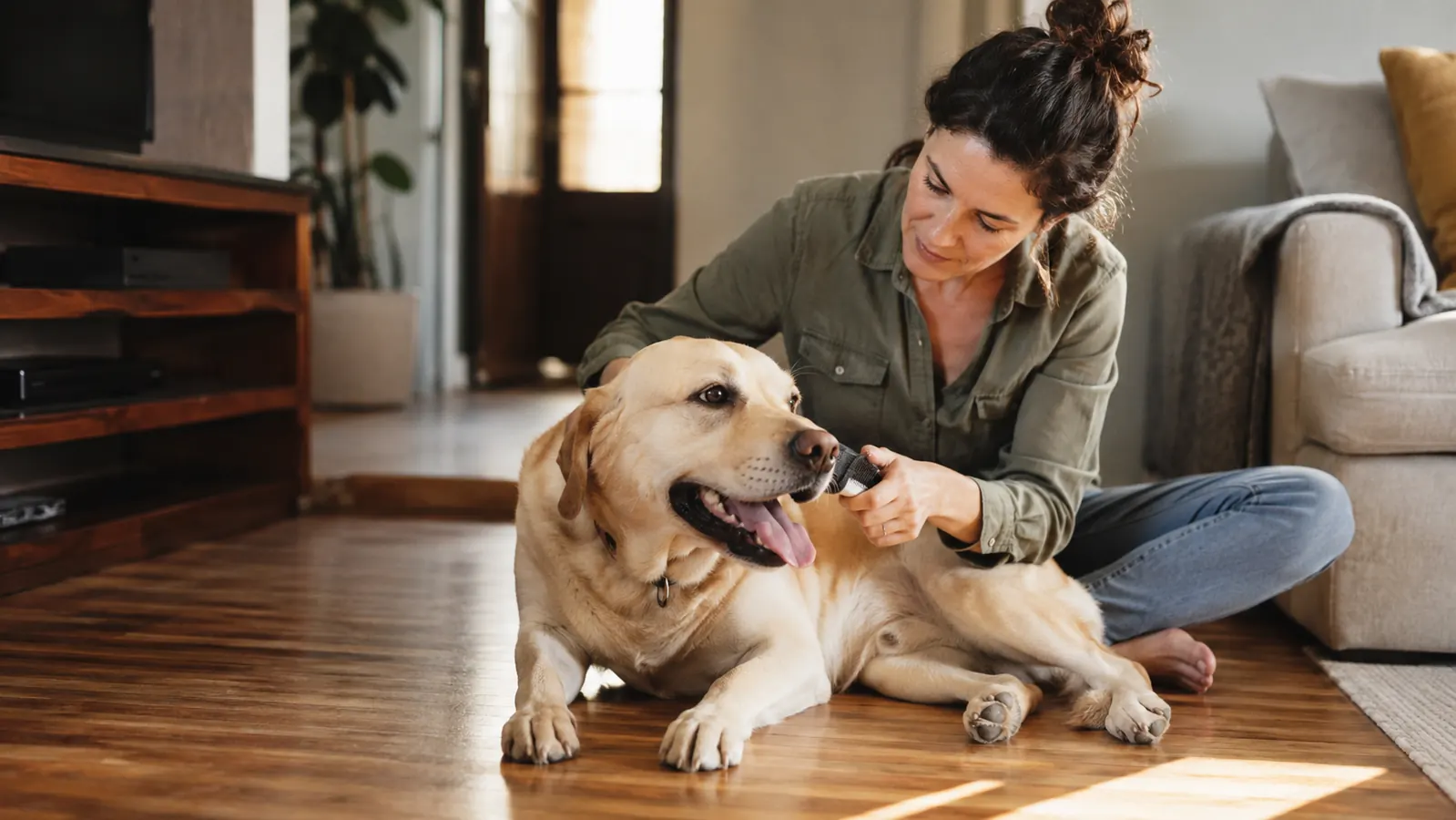
Penny weighs 54 pounds, sheds like a husky in July, and has exactly zero patience for anything that startles her. When I started testing the oneisall Pet Grooming Vacuum with her, the first question I cared about was not how many tools it came with. It was whether she would tolerate the sound long enough for me to actually use it. That is the honest starting point for this review, and it is the one most product pages skip entirely.
I have also worked as a vet tech long enough to know that a grooming tool marketed as 'professional quality' usually means it is better than nothing, not better than a professional. So I went in with calibrated skepticism. I ran Penny through six weeks of every-other-day sessions, tried all seven attachments on both her and my long-haired cat Miso, and paid close attention to the things that will make or break this tool for most pet owners: suction that actually holds up, noise that does not cause a meltdown, a filter that does not clog after three uses, and a cord long enough to groom without shuffling a heavy unit across the floor every two minutes.
The Quick Verdict
A genuinely useful deshedding tool for short-to-medium coated dogs, but the suction is not a vacuum replacement, two of the seven attachments are nearly useless, and dogs with sound sensitivity need a slow acclimation plan before this becomes part of their routine.
Amazon Check Today's Price →If your dog's short coat is covering every surface in your house, this kit is probably worth a look.
The oneisall grooming vacuum captures loose fur at the source instead of scattering it into the air. Check today's price and see the full attachment kit on Amazon.
Amazon Check Today's Price on Amazon →How I Tested It and What I Was Looking For
I set up my testing around the questions I hear most from dog owners who are considering this kind of kit: Will my dog freak out? Does it actually pull loose fur, or just tickle the coat? How long does a session take before the canister fills up? And is the filter going to be a maintenance nightmare?
For noise, I used a basic sound meter app and took readings at arm's length from the unit, with and without an attachment engaged, on both the low and high suction settings. I also ran a comparison against my household upright vacuum to give the numbers context. Penny was present for all readings, which gave me a live behavioral read alongside the decibel data.
For shed capture, I ran a standard slicker brush through Penny's coat for two minutes before each session to collect a reference pile of loose fur. Then I ran the deshedding attachment over an equivalent section for the same amount of time and compared what ended up in the canister versus what the brush had pulled. It is not a laboratory test, but it is the most practically useful comparison I could design, because it mirrors exactly what a real grooming session looks like.
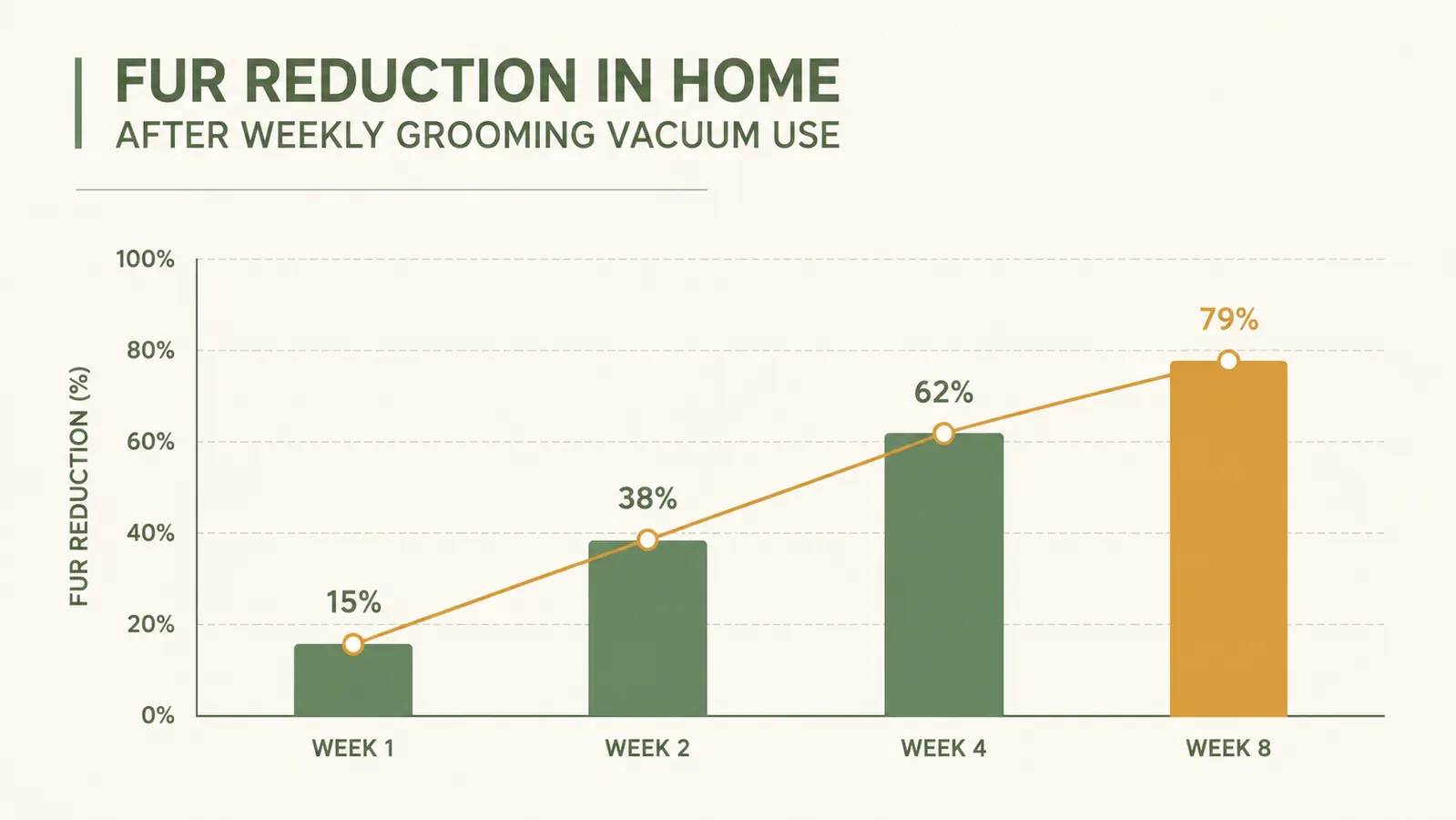
The Noise Level: Better Than Most Vacuums, Still Not Silent
At low suction, the oneisall measured around 62 decibels at arm's length. At high suction, that climbed to about 71 dB. My household upright runs at roughly 78 dB. So yes, it is quieter than a regular vacuum, but it is not the whisper-quiet tool the marketing copy implies. It sounds like a low-pitched hair dryer, and if you have a dog who already reacts to vacuums or blenders, you will need a proper acclimation period before this becomes a stress-free part of grooming.
Penny took three short sessions, each about five minutes, before she stopped walking away from the sound. She never fully relaxed the way she does during a plain bristle brush session, but she got tolerant enough to stand still and let me work through her coat. If your dog is already comfortable with vacuums, you probably skip acclimation entirely. If your dog hides under the bed the moment you roll the Dyson out, budget two to three weeks of short, treat-heavy desensitization sessions before expecting a real grooming outcome.
At 71 decibels on high, it is quieter than my upright vacuum but louder than the marketing makes it sound. Penny needed three sessions to tolerate it. Plan for that.
Suction Reality Check: Not a Vacuum Replacement
This is the thing I most want to be direct about, because it is the place where buyer expectations get set incorrectly. The oneisall grooming vacuum does not suction like a household vacuum. It is not meant to. The suction is sized to pull loose fur through a grooming attachment without pulling so hard that it hurts the skin or sucks the coat flat against the follicle. That is actually by design and it works well for that purpose.
What it does not do is replace your vacuum for floor cleanup. After a thirty-minute session on Penny, I still ran my upright across the area where she was standing and picked up a meaningful amount of fine fur that the grooming vacuum had not captured or that had drifted off the attachment during the session. Think of the oneisall as a capture-at-source tool, not an end-to-end shedding elimination system. It meaningfully reduces how much fur hits the air and the floor during grooming, but it does not eliminate the floor-vacuuming step entirely.
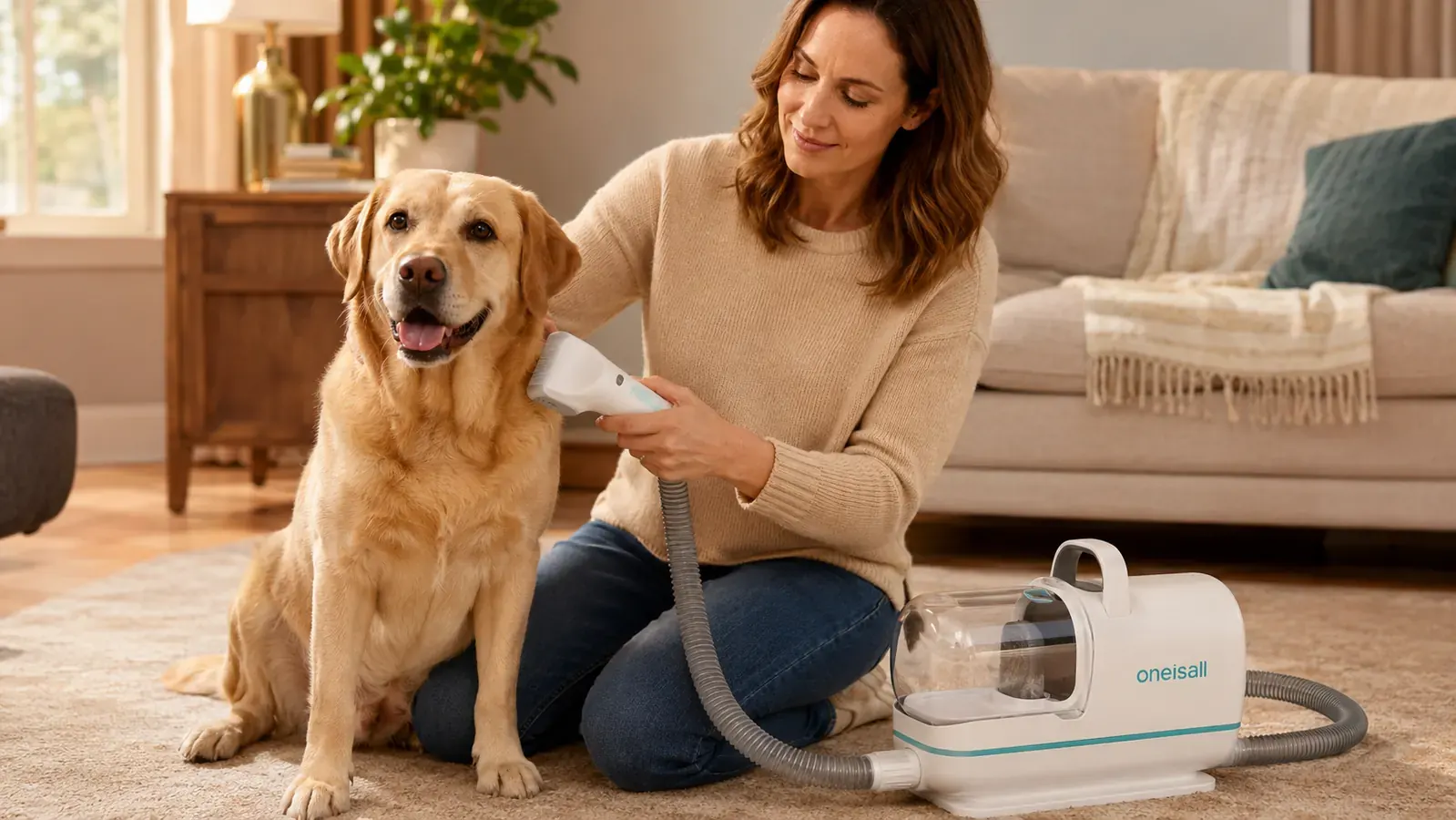
The Seven Attachments: Three Are Great, Two Are Fine, Two Are Gimmicks
The kit includes seven attachments: a deshedding brush, a grooming brush, a cleaning brush, an electric clipper, a nail grinder, a massage brush, and a pet hair cleaning nozzle. Here is my honest breakdown after testing all of them.
The deshedding brush is the reason to buy this kit. It combines a comb-style head with suction and it is genuinely good at pulling the loose undercoat off a short-to-medium coat like Penny's. In my brush comparison test, the deshedding attachment collected roughly 65 to 70 percent of what a manual brush session pulled, with the advantage that it captured the fur instead of launching it into the air. That is a real improvement for anyone who grooms indoors.
The grooming brush and the cleaning nozzle are solid secondary tools. The grooming brush works well for a finishing pass after the deshedding attachment, and the cleaning nozzle is legitimately useful for pulling fur out of upholstery and car seat seams. I keep it clipped to the side of the unit so I can grab it at the end of each session and do a quick pass on the couch cushions.
The clipper and nail grinder both function, but neither is exceptional. The clipper is fine for a light trim around the face and paws on a cooperative dog, but it does not have the torque of a purpose-built grooming clipper, and it will bog down on thick or matted coats. The nail grinder works similarly to entry-level standalone grinders at a lower price point. If you already own a dedicated clipper or grinder, do not expect this to replace them. The massage brush attachment is a filler inclusion. Penny appreciated it as a back scratch, but it contributed nothing to actual shedding reduction.
Double-Coated Dogs During a Blowout: Step Away From This Kit
I want to put this plainly because I have seen this question in forums and the answer matters. If you have a double-coated dog, like a husky, a golden retriever, a chow, a corgi, or a malamute, and that dog is currently in a heavy seasonal blowout, the oneisall grooming vacuum is not the right tool for that moment. The suction capacity is 1.5 liters. A double-coated dog dropping their winter coat can fill that in under ten minutes and the filter will clog before you have made any real progress.
For blowout season on heavy-shedding double-coated breeds, you need a high-velocity dryer to blow the coat out first, followed by an undercoat rake or a Furminator-style deshedding tool, and then the oneisall can come in for the finishing pass. Using it as the primary tool during peak shed will frustrate both you and the dog. In between blowouts, for general weekly maintenance grooming on a double-coated breed, it performs fine.
The Cord, the Canister, and the Filter
The cord is 6.5 feet, which is shorter than I would like. If your dog grooming spot is more than a few feet from an outlet, you will be unplugging and moving the unit or running an extension cord. Neither is the end of the world, but it is something to account for before you set up your grooming station. I ended up using a short extension cord for my kitchen setup and have not had any issues with it, but it is an extra step the marketing does not mention.
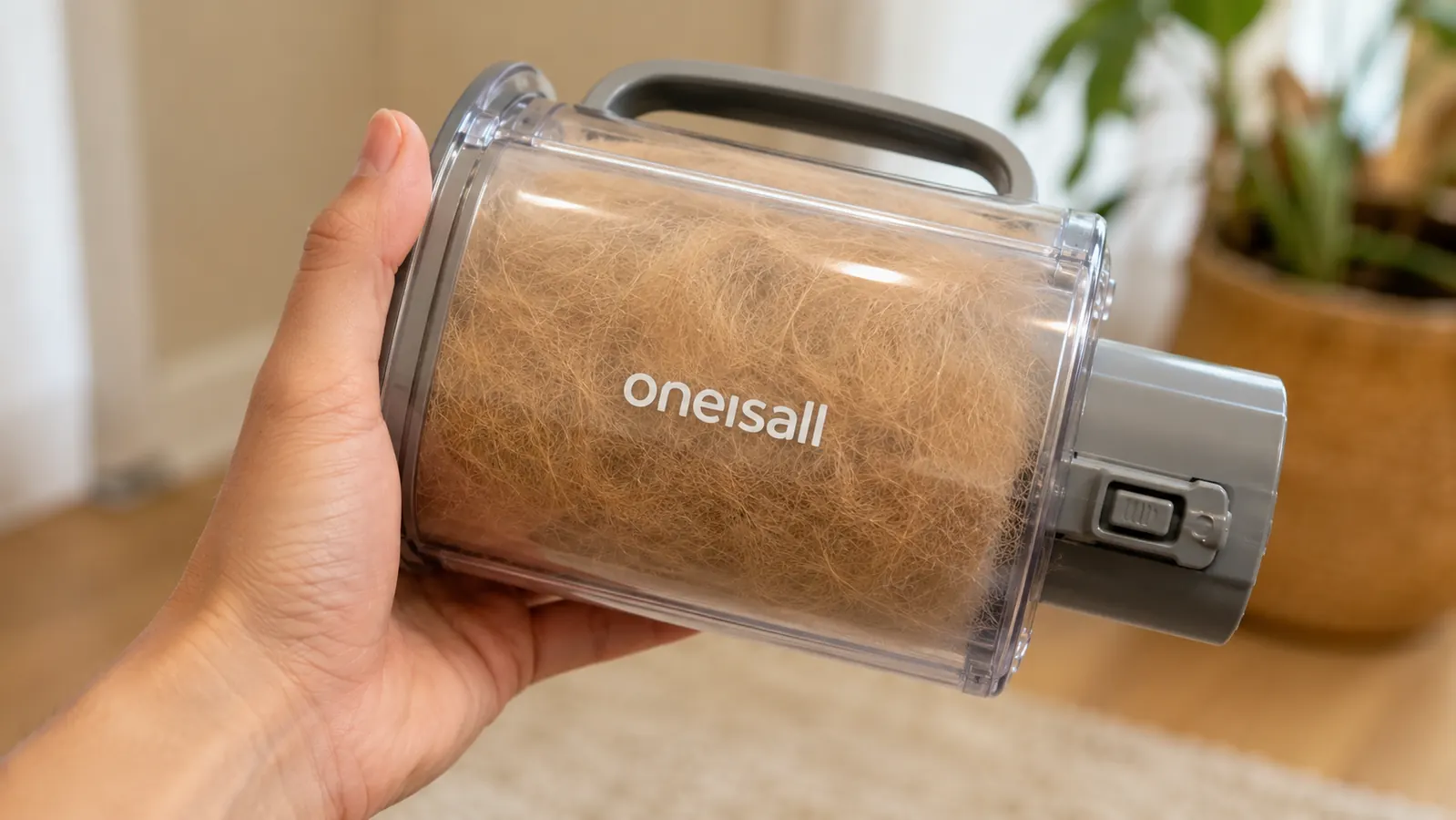
The 1.5-liter canister empties easily and the latch mechanism feels solid. No complaints there. The filter is where most owners run into trouble. Oneisall says to clean the filter after every three to five uses, and that guidance is accurate for a light shedder. For Penny, I had to clean it after every single session or I noticed a real drop in suction partway through. Cleaning is straightforward: remove, tap out the fur over a trash can, rinse under lukewarm water, and let it air dry completely before reinstalling. Do not reinstall a damp filter. I learned this the hard way when suction tanked mid-session and I could not figure out why. Damp filter. Full stop.
My routine now is to clean and rinse the filter at the end of each grooming session, then set it on the counter to air dry overnight. The next morning it goes back in and the unit is ready for the next use. That cycle has kept suction consistent over the full six weeks of testing. If you have multiple dogs, or one very heavy shedder, buy a spare filter from the start so you are not waiting for the wet one to dry before the next session.
What I Liked
- Deshedding brush captures fur at the source rather than scattering it into the air
- Quieter than a standard household vacuum, measuring around 62-71 dB depending on setting
- 1.5-liter canister is large enough for a full session on a medium-sized dog
- Clipper and nail grinder attachments add real utility for owners who want an all-in-one kit
- Grooming nozzle pulls fur out of upholstery and car seats effectively
- Build quality feels solid and the canister latch does not pop open during use
Where It Falls Short
- Suction is grooming-level, not vacuum-level: floor cleanup still requires a separate vacuum after sessions
- 6.5-foot cord is too short for grooming spots more than a few feet from an outlet
- Heavy-shedding double-coated breeds during a seasonal blowout will overwhelm the canister and filter
- Dogs with sound sensitivity need a structured acclimation period before sessions are stress-free
- Filter must be fully dry before reinstalling or suction drops noticeably mid-session
- Massage brush attachment adds bulk to the kit without contributing to shedding control
How It Performed on Miso, a Long-Haired Cat
I want to address the cat use case honestly, because 'dogs and cats' is in the product name and the marketing, and my experience was more mixed than the dog results. Miso is a long-haired domestic cat who tolerates grooming on her own schedule, which is to say, not mine. She tolerated about two minutes with the grooming brush attachment before deciding she was done and removing herself from the situation.
For cats who already accept grooming calmly, the suction level is low enough that it does not create a startling pulling sensation on their skin, and the grooming brush head is shaped reasonably well for a smaller frame. The concern is the noise. Most cats find vacuum sounds genuinely threatening, and adding a grooming tool that sounds like a miniature version of the household vacuum to an already grooming-resistant cat is a reliable way to end the session before it starts.
For Miso, I get better results with a manual slicker brush and a grooming glove, and I accept that some loose hair ends up on the furniture. If your cat is already calm during grooming, try this tool with a very short introduction session and a lot of treats. If your cat growls at the sight of a brush, the vacuum is not going to help the situation.
Who This Is For
The oneisall grooming vacuum is the right fit for owners of short-to-medium coated dogs who shed regularly and who groom indoors. If you are tired of brushing your dog and then spending ten minutes vacuuming the room afterward, this tool collapses most of that into a single session. It also makes sense for owners who want a grooming kit that includes functional clippers and a nail grinder without buying those separately. If you have a dog like Penny who sheds year-round and you groom at home consistently, the time and mess savings are real.
Who Should Skip It
Skip it if your dog has severe sound sensitivity and you are not prepared to invest two to three weeks in systematic desensitization. Skip it if your primary dog is a heavy double-coated breed going through a seasonal blowout, because this tool is not built for that volume. Skip it if you groom outdoors and already blow loose fur off with a force dryer, because the capture-at-source benefit disappears outside. And skip it if you have a cat-only household and your cats are grooming-resistant, because no tool attachment changes a cat's fundamental opinion about the process. For everything else, it is a thoughtfully designed kit that does what it claims for the right dog in the right context.
For a short-to-medium coated dog that sheds indoors, the oneisall kit is one of the more practical all-in-one grooming investments at this price.
Seven tools, a solid deshedding attachment, and a 1.5-liter canister that handles most medium-dog sessions without stopping to empty. See today's price on Amazon and check current availability.
Amazon Check Today's Price on Amazon →